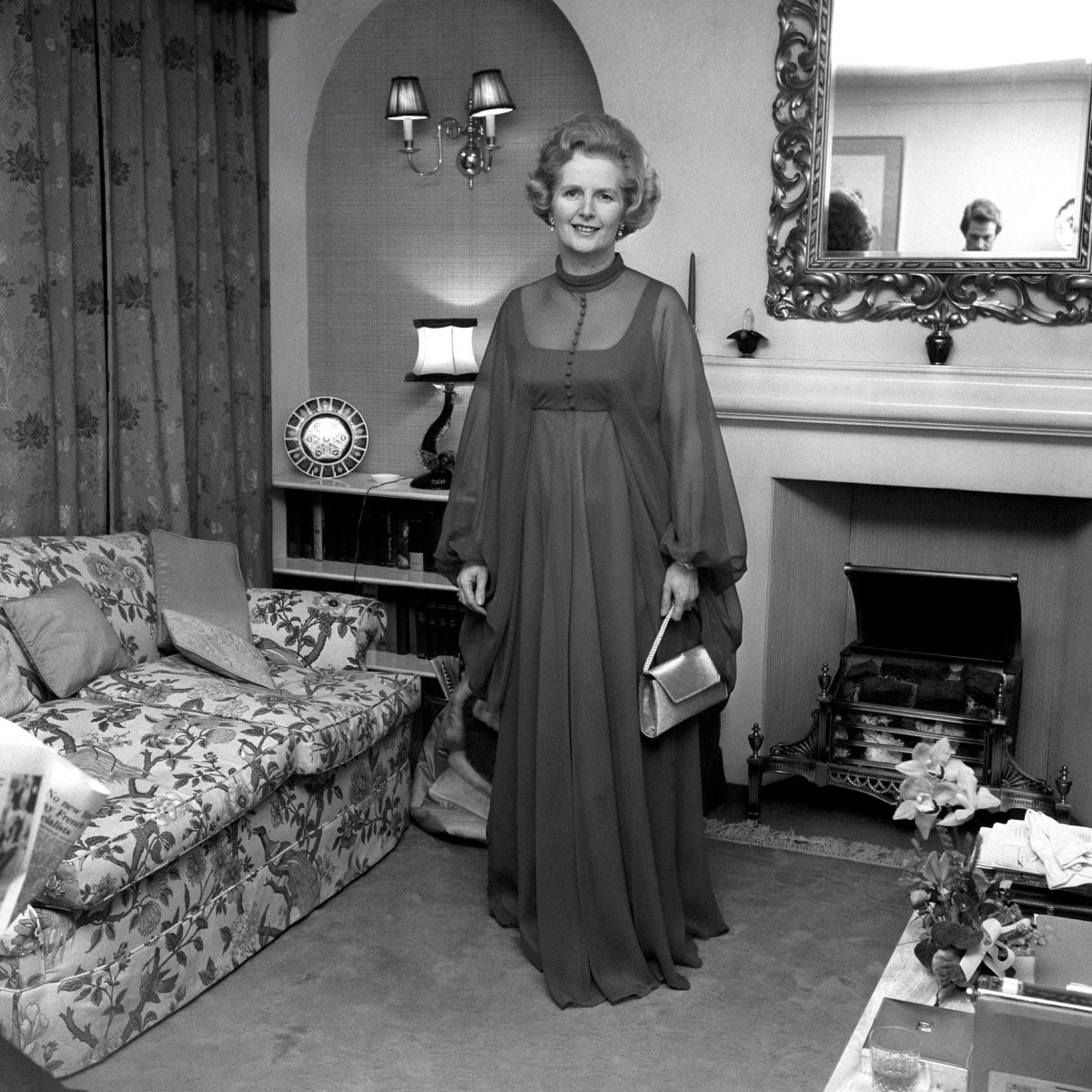
Margaret Thatcher in her chiffon gown on 1 February 1976 (PA Images/Alamy)

4 min read30 October
Fifty years ago, the female leader of the Tory opposition was about to celebrate a newly minted moniker, a gift from Russia
We don’t, sadly, know what was on the menu 50 years ago for the Finchley Conservatives Dinner Dance. Although we’ve all been to a few things like this, and we can be pretty confident that it wasn’t roasted swan in truffle sauce. It was probably chicken. It’s usually chicken. And it wasn’t like it was going to matter. No one was ever going to remember the Finchley Conservatives Dinner Dance of 1976.
Except that they would because of the after-dinner speech made by the local Member of Parliament, Margaret Thatcher. She’d been leader of the opposition for just under a year and was still laying out the direction in which she wanted to take her party. A couple of weeks earlier, she’d made a foray into foreign policy, calling for the country to take a more confrontational stance to the Soviet Union, which was, she said, “bent on world dominance”.
That speech got a big reaction in Britain, but also from Moscow, with the Red Army newspaper, Red Star, provoked into making what was intended as an insulting comparison with Otto von Bismarck, the “Iron Chancellor” of Germany. Mrs Thatcher, said the paper, was “the Iron Lady”. Bob Evans, the Moscow bureau chief of Reuters, spotted the headline and reported it.
A few months earlier, he’d written up a Russian propaganda poster that portrayed the Tory leader as a “Cold War witch”. She hadn’t liked that, but this was different. Thatcher gave her reply to the Finchley Tories. “I stand before you tonight in my Red Star chiffon evening gown,” she said, to laughter and applause – Thatcher wasn’t a natural humourist, but she was among friends that evening – “my face softly made up and my fair hair gently waved, the Iron Lady of the Western world.”
She continued: “Yes, I am an Iron Lady. After all, it wasn’t a bad thing to be an Iron Duke. Yes, if that’s how they wish to interpret my defence of values and freedoms fundamental to our way of life!”
“Yes, I am an Iron Lady. After all, it wasn’t a bad thing to be an Iron Duke.”
There’s a long tradition of insults being adopted by their targets as badges, from the Quakers to the Suffragettes to the Barmy Army. Even “prime minister”, another title that Thatcher would make her own, began life as an 18th-century term of abuse for a royal favourite.
But none has backfired quite so spectacularly as Red Star’s. Thatcher hoped to be Britain’s first female prime minister in an age when some questioned whether a woman was tough enough to do the job. Now the nation’s enemies were suggesting she was too tough for their taste. It couldn’t have gone better if the Tories had scripted the insult for them. Thatcher herself had subtly reinterpreted it as a reference not to the suspiciously foreign Bismarck but to the Iron Duke of Wellington, the man who beat Napoleon.
The rest of that speech in Finchley wasn’t a major one, but reading it half a century later, it offers a good guide to Thatcher’s decade in power: abroad, the desire to confront communism; at home, a belief that the public exercised more control over business through ownership of shares and competition than it ever could through nationalisation, and that people should be free to buy their council homes and choose their children’s state schools.
As a mark of their affection that evening, Thatcher’s association presented her with an inscribed champagne ice bucket. Red Star had given her something far more valuable: a nickname that would be worn as a badge of pride for the rest of her life.